
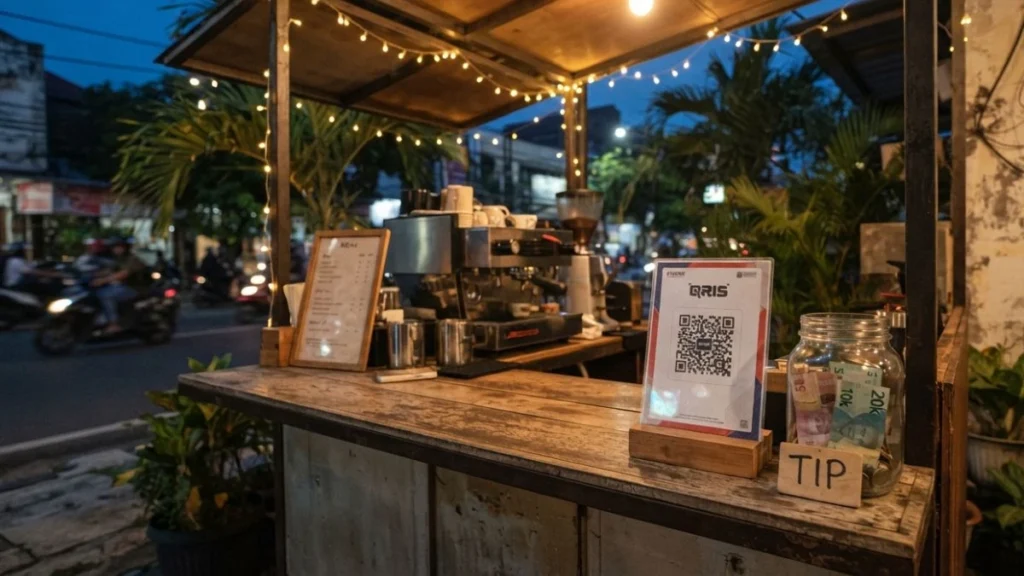
Most day-to-day spending in Surabaya today runs through QRIS, Indonesia’s unified QR payment standard — from street food stalls to shopping malls to public buses. Cash still matters for small local vendors and informal transactions, while credit and debit cards remain mostly confined to malls, hotels, and larger chain stores. Understanding which method works where will save you a surprising amount of daily friction.
What Is QRIS?
QRIS (Quick Response Code Indonesian Standard) is a government-backed unified QR code system that lets any participating e-wallet or banking app scan a single merchant code to pay — regardless of which app the customer or merchant uses. Since its 2019 rollout, adoption has grown rapidly nationwide: more than 57 million users and 32 million merchants, predominantly small and micro businesses, were relying on QRIS for daily transactions as of mid-2025. In practical terms, this means a street food vendor, a coffee shop, and a shopping mall can all accept the same scan-to-pay method through completely different apps.
For a foreigner, the easiest way in is a locally linked e-wallet (GoPay, OVO, or DANA) or a local bank’s mobile banking app — both typically support QRIS scanning once your account is set up. See our bank account guide for how to get a local account that links to these wallets.
Where QRIS Dominates
- Cafes, restaurants, and food courts — nearly universal acceptance, even at small independent spots
- Traditional markets and street vendors — increasingly common, with many individual stall owners displaying their own QRIS code
- Public transportation — Surabaya’s Trans Semanggi Suroboyo bus network accepts QRIS Tap alongside electronic cards and the GOBIS app, making it one of the easiest ways to pay for city buses without carrying cash
- Retail and convenience stores — Indomaret, Alfamart, and similar chains all accept QRIS as standard
- Parking and small services — even informal parking attendants in busier areas now commonly display a personal QRIS code
Where Cash Still Rules
Cash remains the default in a few specific situations: very small or rural warungs that haven’t adopted digital payment, tipping, informal transactions like ojek (motorbike taxi) rides arranged outside an app, and some traditional markets where older vendors still prefer physical Rupiah. It’s worth carrying a modest amount of small-denomination cash at all times — QRIS coverage is extensive but not universal, especially outside central and western Surabaya.
Where Cards Work
Credit and debit cards are accepted at malls (Tunjungan Plaza, Pakuwon Mall, Ciputra World), hotels, larger restaurants, and international chain stores, but far less so at smaller independent businesses. International cards can also carry foreign transaction fees and occasionally trigger declines at machines unfamiliar with non-Indonesian cards — a local debit card tends to be far more reliable for everyday spending once you have one.
E-Wallets vs. Bank Apps
Both routes lead to QRIS, but they serve slightly different purposes:
E-wallets (GoPay, OVO, DANA) are quick to set up, often usable with just a local phone number and minimal KYC for lower transaction limits, and tightly integrated with ride-hailing and food delivery apps. They’re the fastest way to start paying digitally in Surabaya, even before you’ve opened a bank account.
Bank mobile apps (tied to an account like BCA, Mandiri, or PermataBank) offer higher transaction limits, easier salary receipt, and more robust bill-pay features, and can usually top up or link directly to e-wallets. For anyone staying long-term, a bank account paired with an e-wallet is the practical combination — see the bank account guide for setup details.
A Quick Practical Setup
For a newly arrived resident, a reasonable sequence looks like this: download GoPay or DANA immediately using a local SIM card for quick digital payments from day one, open a local bank account once you have your KITAS in hand for salary and rent payments, then link the two together. This covers the vast majority of daily transactions — food, transport, shopping, bills — within the first week or two of arrival.
FAQ
Do I need cash in Surabaya if I have QRIS set up?
Yes, but not much — keep a modest amount on hand for small local vendors, informal transport, tipping, and the occasional stall that hasn’t adopted digital payment yet.
Can I use QRIS with a foreign e-wallet or app?
Cross-border QRIS connectivity is expanding with several regional partners, but for daily use in Surabaya, a locally registered wallet (GoPay, OVO, DANA) or Indonesian bank app remains the most reliable option.
Are credit cards widely accepted in Surabaya?
Mainly at malls, hotels, and larger established businesses — smaller local restaurants, warungs, and markets rarely accept cards, making QRIS or cash the more practical choice day to day.
Is it safe to rely mostly on digital payments in Surabaya?
Generally yes — QRIS is a Bank Indonesia-regulated system with strong merchant adoption, but as with any city, it’s sensible to keep some backup cash for outages, connectivity issues, or vendors without digital payment options.