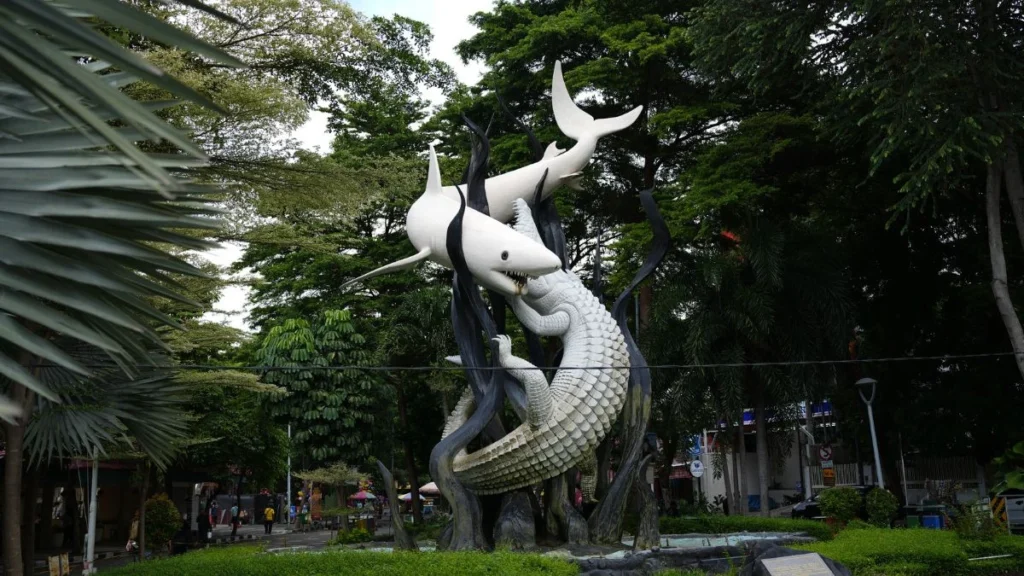
Look closely at Surabaya’s official city emblem and you’ll find two animals locked in combat: a shark and a crocodile. This isn’t decorative flourish — it’s the visual retelling of the city’s founding legend, and the direct source of its name.
The Legend Itself
Surabaya’s name is popularly believed to derive from two Javanese words: “sura” (shark) and “boyo” or “baya” (crocodile). According to local myth, these two powerful creatures fought each other to determine which was the strongest and most powerful animal in the region — a battle so fierce that neither ultimately triumphed outright, but their fight became legendary enough to give the city its name and enduring symbol.
Some interpretations extend the myth further, reading it as an allegorical reference to a real historical conflict — the resistance of the Majapahit Kingdom’s forces against invading Mongol troops, with the shark and crocodile standing in for the two opposing powers rather than literal animals.
An Alternative Reading: “Brave Face of Danger”
A second, less literal interpretation holds that Surabaya derives instead from “Sura Ing Baya,” meaning “brave in the face of danger” — a phrase that fits neatly with the city’s later “City of Heroes” identity, even though it emerged from an entirely different historical period. Whether the name’s true origin lies in the animal legend or this phrase, both readings point toward the same underlying theme: courage against overwhelming odds, a motif that runs consistently through Surabaya’s identity from its founding myth all the way to 1945.
Where You’ll See the Symbol
The shark-and-crocodile motif appears throughout Surabaya in ways that go well beyond the official city seal — as statues at Surabaya Zoo’s entrance, in public art and murals across the city, and as a recurring reference point in local branding, from sports team names to neighborhood signage. Once you know the legend, you’ll start noticing the pairing everywhere, which is part of what makes it worth understanding before you arrive rather than after.
Fact vs. Folklore
Like most city-founding legends, the shark-and-crocodile story sits in the space between literal history and cultural meaning-making — there’s no serious claim that two giant animals actually fought at the site of modern Surabaya. What matters is the story’s function: a memorable, teachable origin myth that both names the city and encodes its self-image as a place defined by struggle and resilience, themes that resurface again and again across Surabaya’s actual documented history.
FAQ
What do “sura” and “boyo” mean in Surabaya’s name?
“Sura” means shark and “boyo” (or “baya”) means crocodile in Javanese — the two animals said to have fought each other in the city’s founding legend, giving Surabaya its name.
Is the shark-and-crocodile story historically true?
It’s a folk legend rather than documented history, though some interpretations read it allegorically as a reference to real historical conflicts, such as resistance against Mongol invasion forces during the Majapahit era.
Where can I see the shark and crocodile symbol in Surabaya today?
It appears on the official city emblem, as statues at the entrance to Surabaya Zoo, and throughout public art and local branding across the city.
Is there more than one theory about Surabaya’s name origin?
Yes — alongside the shark-and-crocodile legend, some scholars propose the name derives from “Sura Ing Baya,” meaning “brave in the face of danger,” which aligns thematically with the city’s later “City of Heroes” identity.